
Day 37: Rest Day in Astorga
We spent an extra day in Astorga to do our chores and to be a tourists for a day. The Cathedral was nice, but, in our opinion, no match for the Leon Cathedral we had visited a few days earlier.


Astorga Chocolate Museum Chocolate also figures prominently in the history of Astorga. In the 15th century, traders brought foreign goods from the port cities of Spain in Galicia by mule to Madrid. Astorga lies along this path and cacao was one of those foreign goods brought from the New World. Chocolate production was a big industry in Astorga, and there still are chocolate factories there. We enjoyed the museum, and really enjoyed the samples of three different chocolates on our way out.


Antoni Gaudí is a famous Catalan architect. Most of his work is in Barcelona, including the amazing Sagrada Familia. However, he was also persuaded to design a residence for a Catholic bishop friend in Astorga. It is now a museum and is quite stunning. We especially enjoyed the stained glass windows.


Day 38: Astorga to El Ganso
On this day we took a detour through Castrillo de los Polvazares, a Maragato village. The profession of the Maragatos was trade in goods, transported by mule and horse carts. Their business model collapsed when the train system eventually reached Madrid. Their houses and streets are made of stone. Remnants of stone corrals lined the road into the village.


El Ganso is also a Maragato village. We ate at Cowboy bar, which is a fixture on the Camino. Good burger, so-so lasagna (think cheap frozen).


Day 39: El Ganso to Foncebadón
This was a shorter day, only 8 miles of gentle climb up to Foncebadón. The terrain and plant life changed from vineyards to pine trees, gorse, and heather. This small village had formerly been pretty much abandoned, but was revived due to the resurgence of modern day pilgrims on the Camino. Everything about the town revolves around pilgrims. Small stores, bars/taverns and accommodations. We had an excellent pizza prepared from scratch by a certified Italian pizza maker.


Day 40: Foncebadón to Molinaseca
The day started with a nice climb up through the gorse and heather to Cruz de Ferro. This is a simple iron cross on top of a 50 foot wooden pole, on top of a mound of stones. The long standing custom is to bring a rock from home, then leaving it at the cross, representing letting go of whatever burden you may be carrying. The religious symbology is to leave the burden at Christ’s feet. I left a feather I had picked up a few weeks ago, in remembrance of my father, a naval aviator. I also left a broken shell for the weight of past mistakes. Experiences like this are as significant as you make them.


The walk down was rocky and slow. At lower elevations it was getting hot by early afternoon. The downward pitch, coupled with uneven rocky surfaces ultimately resulted in a blister for me the next day, though I didn’t notice a hotspot forming.


We passed through El Acebo, which is a preserved medieval town. Later we found a little trailer eatery, run by two French guys. They served non-Spanish food, which was a pleasant surprise. We had their Thai stir fry, which was not really Thai, but it was a good departure from our usual fare.
We stayed in Molinaseca, which was also a charmingly preserved medieval village. Unfortunately, our hostal was about a ten minute walk past the old village, and we were too hot and tired to walk back into town to see it more thoroughly. We talked with a couple of fellow pilgrims in the evening. One was a woman who has enjoyed long distance walking her whole life. Her husband died three years ago and she feels the loss constantly. The other is from Ohio. Her husband encouraged her to walk the Camino, something she had always wanted to do, while he managed things at home with their kids.
Day 41: Molinaseca to Camponaraya
This section took us through the larger town of Ponferrada. Even though we had a long walk ahead of us, we stopped to tour the 13th century Templar Castle. It was an interesting visit and lots of fun imagining what life in a castle would have been like. But we paid for our detour later, as it was very warm later that day. There were thunderstorms after our arrival.


Day 42: Camponaraya to Villafranca del Bierzo.
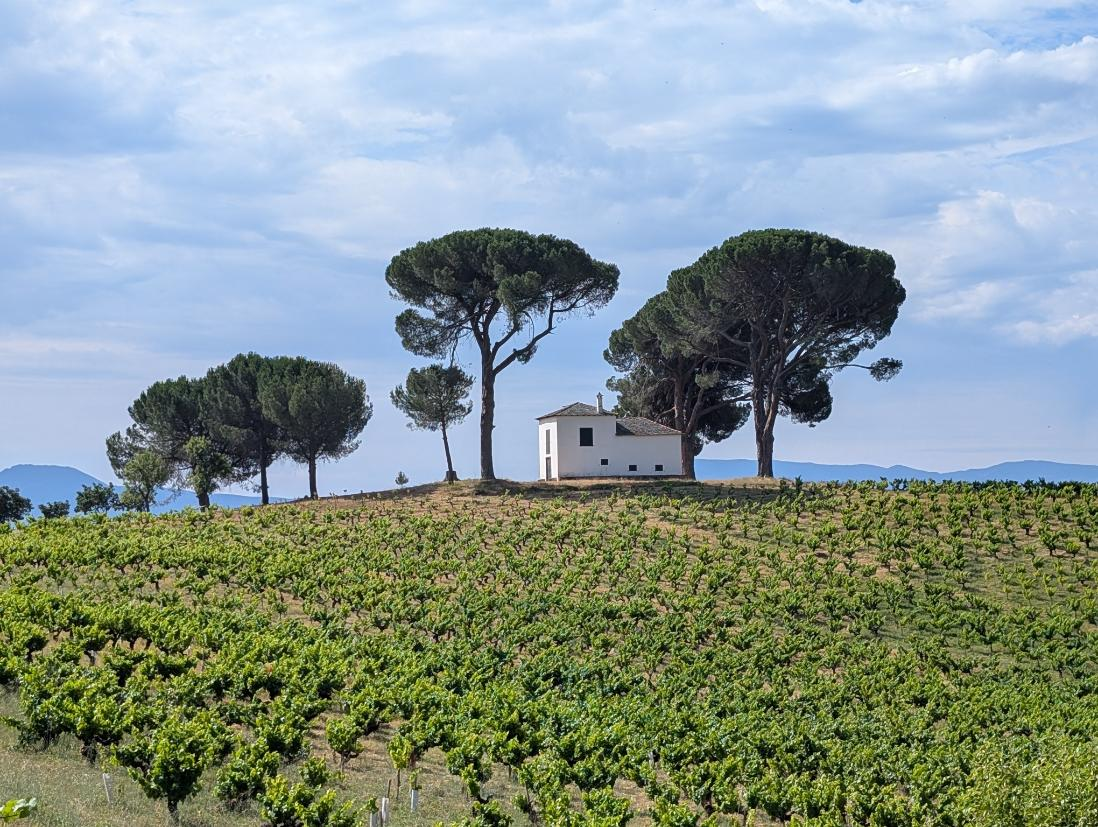
This section was mostly along a road, but there was a section that went through vineyards, which was really beautiful. We bought some cherries from an old guy who set up a table outside a small village we passed through. Once again it was quite warm by afternoon. We stayed in a large hostel and had the Pilgrim’s dinner there. Mixed salad, chicken cutlets and a fish/creamed potato dish. During dinner there was a serious thunderstorm.


Day 43: Villafranca del Bierzo to La Portela de Valcarce.
We walked alongside a road up a long valley by the river. It was not the best walking environment, but the trees and river were nice, and the relative flatness was welcomed by our aching feet. When we stopped at a place for breakfast, a young woman noticed that we had the same shoes that they did, so we took a picture of our feet, and then of the couple. She was from Japan, he was from Taiwan.


We stayed a truck-stop hotel, and since it was also a stop for truckers and other travelers, the cafeteria was open throughout the afternoon, always a bonus to not have to wait for restaurants to open.


Day 44 and 45: La Portela de Valcarce to O Cebreiro
Walked further up the valley along the river then departed the river to climb a steeper grade. We stopped several times along the way for drinks and ice cream and to rest. It was a steep and sweaty but overall beautiful climb into the mountains. The total climb was about 2000 feet.


O Cebreiro is situated on a ridge near the top of the mountains. It has commanding views of valleys on both sides.


O Cebreiro has interesting rounded stone houses (pallozas) with thatched roofs. People lived in one end, the animals in the other end. Many of these have been restored/rebuilt ,but their origins date back to pre-Roman times. The people here had rough lives, practicing sustenance farming of rye and raising animals. The last occupants moved out in the mid 20th century.
This is now a small tourist village, with a mix of pilgrims who spend the night, and other tourists who come in cars and busses during the day.


In the evening we attended the Pilgrim’s Mass in the small 9th century pre-romanesque church. The church went through significant restoration work in the 20th century. This is the oldest church on the Camino. We loved its simplicity, compared to many of the very ornate Gothic style churches and cathedrals we have visited along the way.


After a rest day, we’ll be hiking back down to the valley floor. We only have 11 more walking days until we reach Santiago de Compostela. In about three days, things will get crowded one we reach Sarria. Many pilgrims start there to achieve the minimum distance (100 km) required to earn their Compostela certificate from the Camino Office in Santiago.
Leave a Reply